Why We Exist
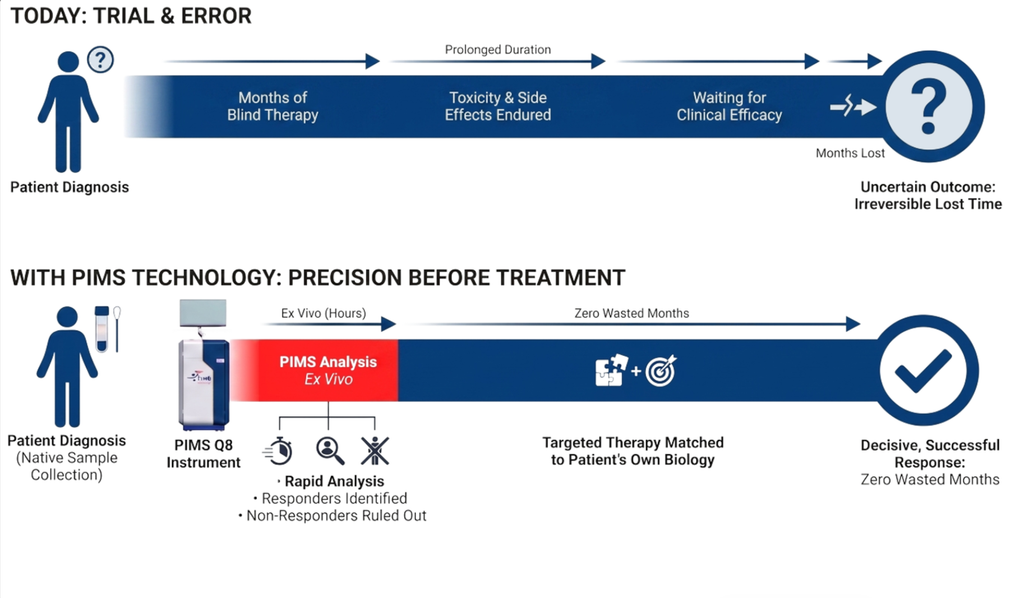
Two patients receive the same treatment. One responds. The other does not. Same diagnosis, same drug, same protocol, different outcome.
Every treatment that fails a patient once passed every test designed to predict success. The problem is not ambition, and it is not a lack of innovation. It is the distance from the patient. Biology is individual, yet medicine is still built on averages.
In most cases there is still no way to know in advance which of the two patients you are. Treatment begins as an informed attempt, and the answer arrives weeks or months later, once time has already been spent. For a patient with cancer, that time is the scarcest resource available. For a patient living with a chronic inflammatory disease, it can mean years spent moving from one therapy to the next, waiting for the one that might work.
PIMS was built to change the order of that sequence.
What PIMS Does
PIMS® answers one question: is this treatment right for this patient.
PIMS puts this question to the patient’s own biology, before the patient takes the drug. A small sample given by the patient, blood or tissue, is enough to see what that biology does in response.
The answer does not come from an average, from statistics, or from what happened to other patients with the same diagnosis. It comes from that patient’s biology, and it establishes whether that biology is responding to that treatment, or not.
The result is available within hours, not after months of clinical observation.
This is the ambition: to move the answer to before, instead of after, the treatment.
Why Cancer and Chronic Inflammation
Oncology and chronic inflammatory disease are the two areas where the same unanswered question does the most damage.
In cancer, the absence of efficacy is measured in months that cannot be recovered. In chronic inflammation, it is measured in years of daily life spent under a therapy that was never going to help, with the side effects that come with it. Beyond the time lost, a mismatched treatment can affect more than the patient’s comfort — in certain situations, it can become life-threatening.
Different diseases, different clinical worlds, one identical question: who responds, and who does not. It is the question PIMS is built to answer, and answering it in both areas is how we demonstrate that the approach holds beyond a single indication.
What We Have Seen So Far
In chronic inflammatory bowel disease, PIMS examined blood samples taken before treatment started and correctly anticipated, in 89% of patients, who would still be responding months later.
In metastatic colorectal cancer, PIMS distinguished patients whose disease had spread from those whose disease had not, correctly in 82% of cases, and identified whether the drug was reaching its intended target in each of them.
This is early evidence, not a finished story. But it points in one direction. The answer is already present in the patient’s own biology, before treatment begins. It only has to be read.
What PIMS Changes
For patients, fewer months spent on an unsuccessful treatment, and fewer side effects endured for no benefit. The goal is not a better average across a population. The goal is to identify the treatment that works for each patient.
For relatives and caregivers, an earlier and more honest picture of what a treatment can realistically do, at the point where decisions are most difficult and time matters most.
For those who fund and develop new medicines, most experimental drugs fail late, after considerable cost, because they were tested on everyone rather than on the patients they could actually help. Reading human biology earlier does not remove that risk. It makes the risk visible while there is still time to act on it.
Where We Are Today
We are at the beginning. PIMS is not yet a test that can be requested in a hospital. We are working with cancer centers, research hospitals and drug developers to get there.
Every study begins with a patient sample. The patient is not downstream of the science. The patient is the science.
What We Are Asking For
This cannot be done alone. The answer we are after does not live in our laboratory. It lives in hospital wards, in patient cohorts, and in clinical trials.
If you work in a cancer centre, a research hospital or a drug development program, and this is a question you are already trying to answer, we want to work with you.
If you are a patient, or close to one, follow us. What we learn, we will report here.
The truth in the tissue. Precision medicine, powered by physics.